


Long stays in Venice: what living here for a month is really like
Most people know Venice for two or three days: San Marco, Rialto, a vaporetto ride, and gone. But there’s another way to be here, and it changes everything: you stay. A week, a month, a whole season. More and more people choose the long stay — remote workers, people who come for the Biennale and don’t leave, researchers, artists on residency, or simply those who want to try living in a place instead of visiting it.
This guide is about what that actually means, with no brochure promises: how it differs from a weekend, what it costs, which sestiere to base yourself in, and what to check before you book an apartment for several weeks.
What changes when you stay (and don’t just pass through)
A short trip is organised around sights. A long stay is organised around routine. You stop chasing attractions and start shopping at the market, recognising the barista, learning what time the bakery pulls the bread out. Seen this way, Venice is far more liveable than it looks to a tourist: the crowds stay confined to three or four arteries — San Marco, Rialto, the Accademia, the station — and everything else goes back to being a neighbourhood.
The biggest practical difference is that you start relying on the things tourists never think about: a real washing machine, a kitchen to cook in every night, a connection that holds up on video calls, somewhere to work without leaving the house. This is where an apartment beats any hotel.
Where to base yourself for a long stay
For two days, location barely matters: you sleep near what you want to see. For a month it matters enormously, but differently. You don’t need to be steps from Piazza San Marco — that’s actually the most expensive and least practical place to live. You need a quarter with real life: grocers, a market, osterie at normal prices, quiet in the evening.
- Castello — the largest, most residential sestiere. Space, liveable campi, daily shopping within reach, and the Giardini della Biennale as the only real green space in the historic centre. Excellent for a long stay.
- Cannaregio — along the fondamenta of the Misericordia and the Ormesini it’s one of the liveliest, least touristy areas, with bacari full of Venetians and a good balance of calm and sociability.
- San Polo — handy if you want the Rialto market on your doorstep and like being in the city’s commercial heart; toward the Frari and San Tomà it grows quieter.
- San Marco — the absolute centre. Pricier and busier, but if your reason for being in Venice is to be inside everything (institutions, events, evening life) it makes sense. Look for the side calli, not the views over the piazza.
- Dorsoduro — close to the university, the galleries and a steady cultural scene. A good fit if you’re here for artistic or academic reasons, though prices run higher.
What a month in Venice actually costs
Let’s be honest: a long stay in Venice isn’t a cheap residential rental. But it costs far less than stacking up thirty nights at tourist rates. Long-stay apartments offer monthly rates discounted against the short term, and you save on other fronts too: you cook instead of eating out, you skip OTA commissions by booking directly, and you stop paying the tourist tax after a certain number of nights.
That last point is concrete: in Venice the tourist tax applies for a maximum of five consecutive nights. From the sixth night on, you no longer pay it. It’s a real, if modest, saving — and a signal: the city itself effectively rewards those who stay rather than pass through.
Costs to budget for:
- The apartment’s monthly rate, varying by size, sestiere and season
- Utilities: usually included in furnished stays, but always ask whether there’s a consumption cap
- Daily shopping: the market and neighbourhood supermarkets (Coop, Despar) keep costs down; eating out every night does not
- Transport: a single vaporetto ticket is €9.50, so a pass pays off quickly if you travel by water (see below)
Rule of thumb: the longer the booking, the more room there is to agree a rate. Low season, November to April, is the best time to land the best conditions.
Why an apartment beats a hotel for a long stay
In a hotel, after a week the room starts to close in: no kitchen, breakfast on a fixed schedule, nowhere to really work. An apartment solves almost all of it. You cook when you like, with what you bought at the market. You have a washing machine, so you travel light. You have a table, a desk, a proper connection. And you have free hours: in Venice, where the city empties and falls silent in the evening, being able to come home to your own place makes an enormous difference.
Getting around: walking comes first
You can cross almost all of Venice on foot in a little over half an hour, end to end. For a long stay this is the most important thing to know: many guests use the vaporetto only a handful of times, mostly for the airport and the islands. You walk, and within two weeks you know the shortcuts better than the map.
If you do plan to travel often by water, the single ticket (€9.50, valid 75 minutes) is quickly offset by a pass. Tourist passes, though, top out at seven days (€65). For a genuinely long stay it’s worth registering a personal Venezia Unica card, which unlocks monthly passes at rates far below buying day-passes one after another.
Acqua alta, damp, and the truth about winter
Honesty here too. Venice in winter is damp, and acqua alta is real — but it’s predictable. The city publishes tide forecasts hours ahead, there are dedicated apps, and raised walkways keep you moving even at the peaks. A pair of rubber boots and the habit of checking the tide in the morning solve 90% of it. It’s worth choosing an apartment on a raised ground floor or an upper floor if you come in the higher-risk months (November–December).
That said, winter is probably the best season for a long stay: low prices, a liveable city, mist on the canals, osterie full of Venetians rather than tourists. It’s the Venice the people who actually live here prefer.
Groceries, routine, and living like a local for a few weeks
This is the real pleasure of a long stay: the routine. The Rialto market early for fish and vegetables, the neighbourhood Coop or Despar for everything else, the bakery for bread. Cooking at home isn’t a fallback here; it’s the most natural and most economical way to eat well. And after a few days the city stops feeling like a museum and starts feeling like a place where you live.
What to look for in a long-stay apartment
Not every holiday apartment holds up over a month. The things that genuinely matter over the long term are few and concrete:
- Real fibre internet, not just any connection, if you need to work or take video calls
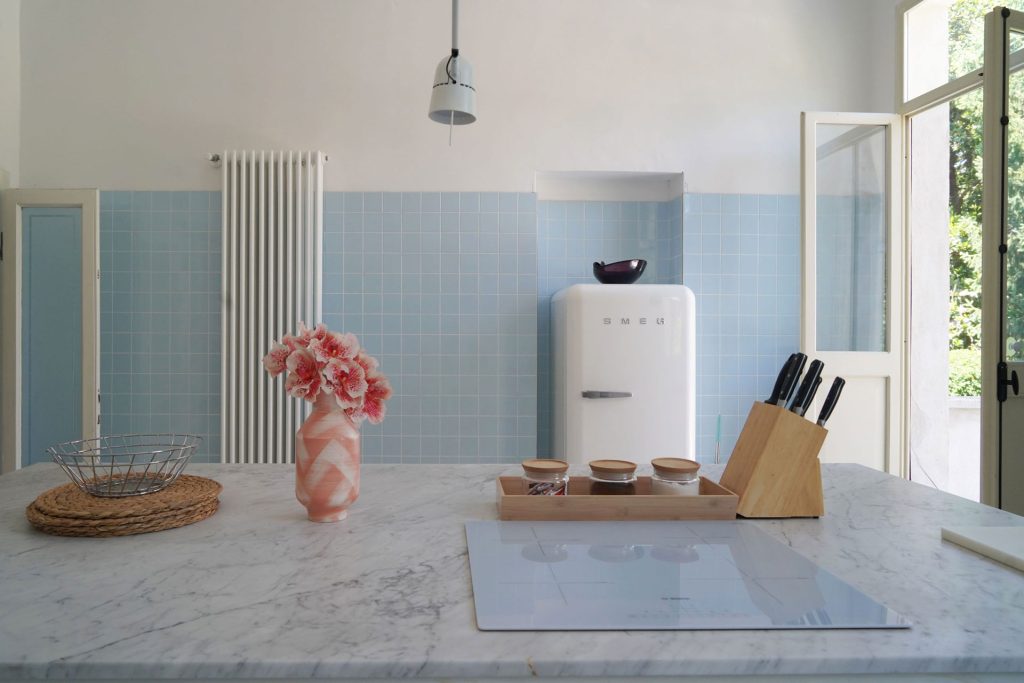
- A full kitchen and a washing machine in the apartment, not shared
- Independent heating that works (the Venetian winter is damp)
- A quiet area, but with shopping nearby
- Ground floor or a low floor if you travel with heavy luggage or dislike Venetian stairs
- A clear monthly rate and the option to book directly, commission-free
Melusina Homes runs apartments in Venice built for people who stay a while: full kitchens, a washing machine, fibre internet and reduced rates for stays of several weeks. You book directly — no OTA commission — and from the sixth night the tourist tax no longer applies. Tell us how long you’re staying and when, and we’ll find the right apartment and rate for you together.
FAQ
How is a long stay different from a residential rental in Venice?
A long stay is a furnished holiday let, already equipped and with utilities included, without a residential lease. You book for weeks or months at a reduced rate, find everything ready, and skip the hassle of connections, furniture and paperwork. It’s the right option if you’re in Venice for work, research or a temporary project.
How much do you save on a long stay versus short-term rates?
It depends on the apartment and the season, but the saving comes from several directions: the monthly rate is discounted against the nightly one, you cook rather than eat out, booking directly avoids OTA commissions, and from the sixth night you stop paying the tourist tax. Low season offers the best terms.
Do you pay the tourist tax on long stays in Venice?
Only partly. In Venice the tourist tax applies for a maximum of five consecutive nights: from the sixth on, you no longer pay it. Note that the count resets if the stay is broken and resumed later.
When is the best time for a long stay in Venice?
November to April. Accommodation is cheaper, the city is calm and liveable, and the osterie fill back up with Venetians. The only thing to plan for is acqua alta in the higher-risk months, but it’s predictable and manageable.
Do I need a vaporetto pass to stay a month?
Not necessarily: you can walk almost everywhere in Venice, and many guests use the vaporetto only for the airport and the islands. If you do travel often by water, a single ticket is €9.50; tourist passes top out at seven days. For long stays it’s worth registering a Venezia Unica card and loading a monthly pass.
A month in Venice? Start here..
Melusina Homes runs apartments in Venice built for people who stay a while: full kitchens, a washing machine, fibre internet and reduced rates for stays of several weeks. You book directly — no OTA commission — and from the sixth night the tourist tax no longer applies. Tell us how long you’re staying and when, and we’ll find the right apartment and rate for you together.

Melusina Homes: apartments in the heart of Venice for authentic stays. We welcome you year-round in thoughtfully designed apartments, with easy check-in, responsive support, and trusted local recommendations.
MELUSINA HOMES
INFO
Masin Services srl
Sestiere Castello 6661
30122 Venice
P.IVA 04496330277
Privacy Policy
Cookie Policy
